Your Ultimate Guide to Contractor Fall Planning and Preparation
Don't just survive the seasonal shift. Use our fall contractor checklist to prep your crew, maintain fleet equipment, and maximize Q4 profit margins.
Published on Aug 27, 2026

Essential Q4 Preparation Milestones
Effective contractor fall planning allows you to transition smoothly from summer projects on exteriors to more profitable jobs in Q4 without decreasing your crew’s efficiency.
A seasonal checklist for inventory, materials, and equipment preparation can help you save time and money.
Smart scheduling, staffing adjustments, and customer communication make seasonal construction prep more profitable and less stressful.
Targeted marketing based on lost bid reasons and year-end urgency can help you capture last-minute budget spend before December closes.
The natural reaction for most contractors when the seasons change is one of survival mode. It’s far better to approach contractor fall planning as a profit opportunity. With the right fall planning strategy, you can ensure that crews are occupied, margins are secure, and you have the ability to capture those projects that customers want to be completed by year’s end.
It is particularly true for regions such as Missouri and the Midwest, where outside construction winds down, while inside projects increase in value. The proper seasonal construction prep enables you to work around weather conditions, stock up early, and use Q4 as a way to make money rather than scrambling for it. Businesses that work around the dates and deadlines rarely find themselves in any bottlenecks.
Contractor Fall Planning: Why Q4 Preparation Drives More Revenue
How Seasonal Shifts Change Demand for Contractors in the Midwest
In the Midwest, autumn does not simply extend the summer, but rather acts as a transition period in which outside construction is dependent upon the weather, and inside construction is dominant. That means your contractor fall planning should reflect demand swings by trade, project type, and local climate patterns.
For instance, roofing, painting, fencing, and landscaping become more constrained by weather conditions, while such works as flooring, renovations, and repairs are likely to experience growth due to indoor work. Those contractors who learn about the trends ahead of time will be able to prepare their bids, labor, and materials in advance.
Why Proactive Planning Beats Reactive Scheduling During the Fall Rush
Reactive scheduling tends to involve project delays, urgent purchase of materials, and people waiting around for things to happen. A proactive approach to construction work in Q4, however, means exactly the opposite – work orders depend on season, lead time, and quick project implementation.
And that is significant because end-of-year demands can change rapidly. By the time the weather turns cold, your plan will be crowded, your suppliers strained for support, and your clients not as tolerant about timing issues. And that gives you much more flexibility with respect to price and labor scheduling.
Turning End-of-Year Budgets into Profitable Project Opportunities
One of the most overlooked parts of contractor fall planning is budget capture. Homeowners, HOAs, property managers, and businesses often have funds left to spend before year-end, especially if they need to preserve maintenance budgets or close out capital improvements.
Use that to your advantage. Promote projects that can be approved and completed quickly, such as repairs, interior refreshes, safety upgrades, and weatherproofing. The goal is not just to fill the calendar, but to sell the kind of work that fits the season and can be delivered efficiently. If you are refining your pricing and offer structure, start with a clearer view of professional bids so your proposals stay competitive and profitable.
Build a Seasonal Construction Prep Checklist for Inventory and Materials

Forecast Material needs for Interior and Weather-Dependent Projects.
Inventory planning is probably one of the most pragmatic components of the preparation for the season in the construction industry. First of all, analyze those project types that have won in the previous autumn season and what types of materials were required compared to summer projects.
The forecast should cover the list of commonly used items, long lead materials, protection materials, and seasonal materials. You definitely understand how easily it reduces margins when there are people who have been waiting for one item.
Reorder Fast-Moving Inventory Before Supplier Delays Hit
The supplier’s delay in delivery can be overlooked until you run out of your best-selling products because of back orders. It is wiser to replenish quickly moving products and maintain buffer stock of the products which are used most by your employees.
According to small business holiday planning guidance, reviewing demand trends and building extra stock for best-selling items is one of the clearest ways to avoid lost sales during peak season. Contractors can apply the same logic to fall by stocking the materials most likely to move quickly as temperatures drop and timelines tighten.
Use Project Type Filters to Align Stock with Fall Demand
The use of filters on your projects will allow you to link the items in your inventory to the demand as opposed to making guesses. If you have the ability to filter your jobs based on trade, seasons, or scope in your CRM or job management process, you can use the filters to determine what items are currently in demand and what will come up later.
For instance, you might know that there will be an increase in roofing wrap-up, flooring installations, and interior repair jobs. In this case, the project type filters will be beneficial to you.
Fall Equipment Maintenance That Keeps Crews Working
Inspect and Service Equipment Before Cold-Weather Breakdowns
Colder weather will quickly highlight any problems with equipment compared to summer. This is because batteries lose their effectiveness, fluids get thicker, tires wear differently, and small problems become large ones when crews start working out of the office daily. For that reason, fall equipment maintenance needs to be completed before the first cold front hits.
Begin by checking the obvious, such as braking systems, belts, filters, hoses, batteries, and heater systems on trucks and trailers. Next, check equipment used on the jobsite like air compressors, lifts, and generators. Missouri Extension advises the consistent inspection and maintenance of equipment and facilities as an important practice.
Prioritize Fall Equipment Maintenance for High-Use Tools and Vehicles
It is not necessary for all the tools to get the same priority at all times. Start off by servicing the equipment that is used by your teams on a daily basis or equipment that would lead to expensive losses if any kind of problem arises while executing high-value projects.
You should also consider inspecting heaters, defrosters, charging systems, and emergency kits. The cost of servicing the equipment at this stage will turn out to be way cheaper than repairing it at a roadside or losing out on a weather window later.
Create a Maintenance Calendar to Reduce Downtime in Q4
The calendar will serve you better than memory, especially if the season becomes hectic. Create reminders for your periodic inspections, oil changes, battery testing, winterizing processes, and calibrations. This way, maintenance becomes organized rather than reactive when your machines break down.
To achieve optimal success, it is essential to link your maintenance schedule with your personal schedule. In case a truck or piece of equipment is due for maintenance, avoid assigning such trucks or equipment to jobs that are not tolerant to such delays. Maintenance calendar scheduling helps contractor fall planning.
Q4 Contractor Strategy for Scheduling Crews and Project Types
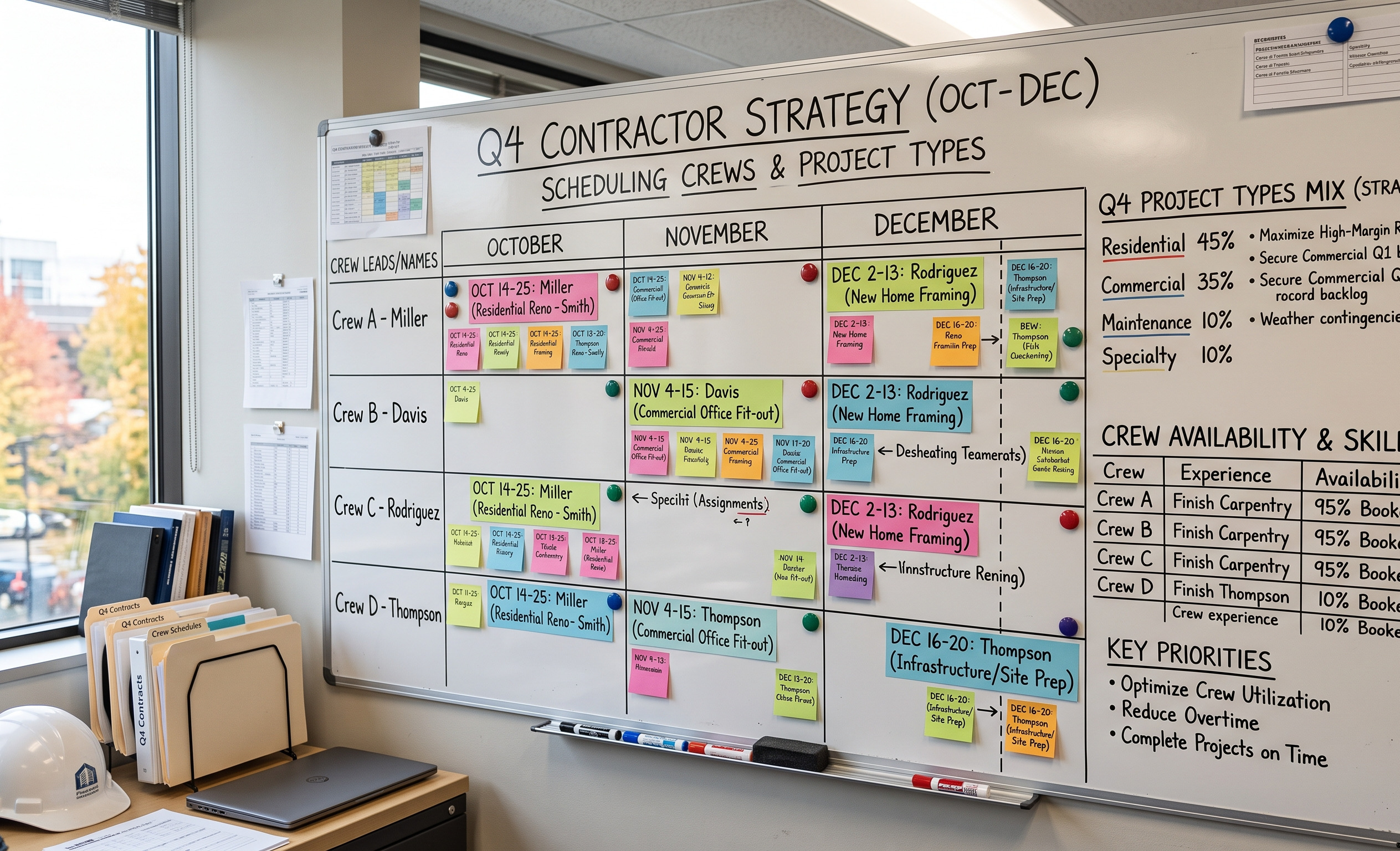
Schedule Weather-Dependent Work First to Protect Timelines
Weather-sensitive work should be front-loaded whenever possible. That means jobs like roofing repairs, exterior sealing, drainage improvements, and other time-sensitive tasks need to be scheduled earlier in the fall while conditions are still favorable. This is a core part of any reliable Q4 contractor strategy.
If you take your time, the task becomes difficult to accomplish and sell. A good schedule takes into account the work that requires the smallest window of weather and then fills up the rest of the schedule with indoor work which is independent of temperature.
Balance Exterior Wrap-up Projects with Interior Work for Steady Production
An optimal autumn schedule needs to combine urgency and stability. Exterior wrap-up work can provide good income even in the fall season, yet it also needs to be supplemented by interior work in order to ensure crews are occupied despite weather problems such as rain, frost, or snow. And this is the very core of seasonal construction preparation.
In order for this to be achieved, the schedule needs to be built with due regard for the duration of the project, possible weather complications, and crew specialties. Knowing which activities can be carried out under any weather conditions and which cannot will help avoid interruptions in the construction process.
Set Customer Expectations Early to Prevent Delays and Change-Order Friction
Autumn jobs become more dependent on timing, which implies that customer communication will play a greater role than ever. Discuss any possible issues with delays because of bad weather, time frames for approvals, and materials availability before starting the job so that customers understand how things work this season.
Clear communication will also allow dealing with change orders more efficiently. As studies have shown, customer communication will allow contractors to keep clients in the loop while not overwhelming them, and this can be particularly helpful when dealing with flexible schedules.
Keep crews productive by matching job scope to seasonal conditions
If it gets cold, low productivity may occur due to assigning the wrong tasks to the crews. Properly matching job size to climate will enable you to maintain the pace. Assign the appropriate people to the right task according to weather exposure, material needs, and weather tolerance for each project.
It is also useful to group tasks by being either weather sensitive, weather tolerant, or weatherproof. This will make scheduling much easier, keep your crew working, and minimize the chance of having all work stopped because of a cold front for an entire week.
Staffing Adjustments for a More Profitable Fall and Winter
Adjust crew size and labor mix based on project pipeline
Your fall labor force should match the pipeline, not routine. If you’re experiencing decreased external work volumes and increased internal labor demands, your labor structure will have to adapt to maintain profitability. This could involve spending less labor on the field and more on specialization.
Analyze work ahead by trade type, project size, and completion date. If the next 60 days look less busy than the summer months, optimizing labor now will help cash flow and eliminate wasted labor time. This is an efficient means of turning contractor fall planning into something profitable, as well as organized, for your contracting company.
Cross-train team members for interior and cold-weather work
Cross-training provides more flexibility if the schedule changes. If someone from your crew can assist in the punch list, interior prepping, small demo work, or winterizing, this makes them extremely useful when weather causes an interruption in the usual flow of events.
It will also help you to avoid problems with scheduling and overbooking of some tradesmen. You do not have to leave these people sitting around with nothing to do; instead, you could utilize them by assigning them another important task.
Plan overtime strategically without hurting margins
Overtime will get you caught up during the fall rush, but you need boundaries. Apply it to the correct jobs, for the appropriate amount of time, and only if the dollars justify it. Otherwise, the cost of labor may consume all of the profit that you have generated.
Create a policy for approving overtime and measure it against the gross margin. If it’s going to take more hours to complete the job, ensure that the schedule, pricing, and deadlines of the job warrant the expense. A strict labor policy is one of the easiest ways to improve your Q4 contracting strategy.
Marketing Pushes That Help Contractors Capture Last-Minute Q4 Work

Use lost bid reasons to build targeted seasonal campaigns
However, rejected bids are not merely losses, but rather market insights, which one needs to keep track of in order to capitalize on these losses by formulating seasonal campaigns addressing any pricing problems, timing problems, or even lack of services. It is the intelligent way for a contractor to fall planning to assist in selling in the future.
To illustrate, if you have heard from your potential customers that they require the start date as soon as possible, then your next message should concentrate on availability and quick lead time. On the other hand, if the problem was price, then one should formulate the message that addresses their pricing concern.
Refresh messaging around urgency, availability, and year-end deadlines
In Q4, there is a sense of urgency because your clients are under time constraints. They need their work completed before the weather gets bad, before they entertain for the holidays, or before they start a new budget year.
Use short, clear messaging around limited availability, scheduling windows, and year-end completion. Small business seasonal guidance emphasizes that a strong marketing calendar and consistent messaging help businesses stand out during the busiest months of the year.[5] Contractors can apply that same principle by making the benefits of fast action obvious.
Focus ads on homeowners and businesses with unused budgets
Not all leads are created equal during the fall season. The best leads can be found in individuals and businesses that have cash to burn until the end of the year. Those types of people or companies typically need maintenance, improvements, or to wrap up projects.
Focus on reaching out to property managers, commercial customers, and returning clients that might have some cash left in their budgets. With the right message geared towards the seasonal push, the advertising can reel in jobs that might be delayed until next year.
Re-engage past leads with fall-specific offers and follow-ups
Prior contacts tend to be the easiest closes in an off-season environment. They have already heard about your business, and perhaps all they needed was a little incentive to get started again due to the particular season.
Consider a check-in that references weather timing, maintenance needs, or year-end scheduling. If you maintain a clean follow-up process, this can become one of the most dependable parts of your contractor fall planning system. For a stronger follow-up workflow, use customer communication tools to automate reminders and keep prospects warm.
Frequently Asked Questions
What should be on a contractor fall planning checklist?
An effective list would include inventory forecasting, reorder points for high-turnover materials, equipment inspection, adjustment of staffing, and even a fall marketing blitz. Project sequencing should also be included to ensure that weather-sensitive projects are completed before the peak of the season hits.
How do contractors keep crews productive during the fall and winter?
Ensure that productivity remains high by having crews alternate between wrapping up exterior work and interior projects based on the needs of each individual project. Cross-training is a must in order to keep your team moving from one project to another without downtime.
Why is fall equipment maintenance so important for contractors?
The maintenance of the equipment in the fall will help contractors avoid any malfunction at low temperatures and high loads.
How can contractors use lost bid reasons to get more work in Q4?
The reasons why a bid was lost can help contractors find out which were the concerns of the prospect: price, time frame, or project scope, and use that knowledge to create their fall marketing campaign.
What kind of projects are best for Q4 contractor strategy?
The best Q4 projects are those that can be completed efficiently before year-end or handled despite changing weather. Interior remodels, repairs, weatherproofing, and maintenance work often perform well because they are less likely to be derailed by seasonal conditions.
Fall is the season when you should think about Q4 as planning time instead of a time of slowing down. Those who will make the most out of Q4 will be the companies that have done their homework, prepared ahead, and taken the best out of seasonal changes. With contractor resources, you will always have the chance to keep improving on that approach.
Recent Articles

October 20, 2026
How to Build Trust Before the First Sales Appointment

October 15, 2026
The Cost of Disconnected Contractor Software

October 13, 2026